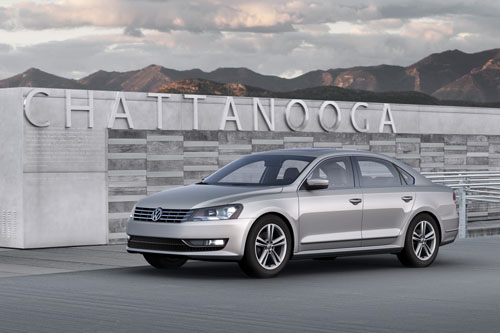
The new VW Tiguan is here. An SUV design the largest parallel Touareg. An SUV with gasoline engines as powerful and more efficient fuel consumption is 5.3 liters per 100 km for both front-wheel drive Volkswagen Tiguan 2.0 TDI BlueMotion Technology (81 kW / 110 hp and 103 kW / 140 hp) . An SUV that turns off the engine completely as possible in city driving, with a stop / start system. An SUV is an ideal, versatile companion for life on the road with his excellent performance overall, a great feature, 1510 liters of cargo space, up to 2,500 kg towing weight (with 4MOTION four-wheel drive) and many thoughtful features. A Volkswagen in the best sense of the word! In Germany refined the Tiguan will be available in mid-June 2011, other European countries will follow in early August and overseas markets in late August.
A van, two worlds
The front and rear design has been completely revamped. Volkswagen Tiguan is still the only SUV in its class that can be ordered in two different versions: one for the road and a specially adapted for off-road driving. Visually, both models are distinguished by their front ends ("On the Road" has a 18 degree angle of approach, "Off-Road" 28 degrees). Both models are now showing greater independence, improved dynamics and more stylistic precision. Moreover, as the version on the road off-road version is now also available with front-line equipment. In this case, off-road specialists, known as Track & Style (road " Sport & Style ").
Systems high-tech security
Model, and a new auxiliary systems such detection difficult (standard on "Sport & Style" and "Track & Style"), a camera-based control of light beams Assist (H7 lights) and dynamic light Assist (bi-xenon) , as well as Lane Assist lane change to keep the system now expand the range of features found in the VW Tiguan. In addition, the new Tiguan: XDS electronic differential lock.
110 hp 210 hp
Powertrain Technologies have become more fuel efficient. Three of the seven engines available in Europe - all charged four-cylinder engines with direct injection - the Tiguan is a new line-up. Petrol engines four strong (STI with 1.4 to 2.0 liters displacement) occurs between 90 kW / 122 PS and 155 kW / 210 hp. The three powerful diesel engines (TDI) covering a power range of 81 kW / 110 PS to 125 kW / 170 hp. Also available as an option on the new Volkswagen Tiguan is the 7-speed dual clutch transmission (DSG) - a more efficient transmissions and sports cars.
One of the SUV more fuel efficient in the world
All versions of the Tiguan BlueMotion technology has a start / stop system and regeneration of the battery. The result: even with AWD, 103 kW / 140 hp 2.0 TDI 4Motion Volkswagen Tiguan BlueMotion technology, for example, consumes just 5.8 liters per 100 km! Obviously, this is one of the most fuel efficient SUV in the world of Volkswagen. As before, the entry level engines are offered with front-wheel drive. TDI and 140 hp front wheel drive is available as an alternative. That's like a Volkswagen TDI, even managed to break the barrier of 5.5 liters to 5.3 l/100 km of fuel into account.
The best-seller right from the beginning
The new model replaces the Tiguan, which has experienced a great story of success in Germany, where its market introduction in 2007, Volkswagen Tiguan sprints from zero to become the market leader in SUVs. It did not give this position: Although the launch of the new Tiguan, Volkswagen announced in February 2011, the model "old" has continued to place first in new car registration for all sport utility vehicles in Germany. Even more impressive: just before the production stopped, was the fourth best-selling car passengers after the Golf, Polo and Passat. Very few cars - where they can be placed all over the world - an experience so successful in the final!
An SUV for all continents
Internationally, the VW Tiguan has long been one of the most coveted and Volkswagen. Its highest volume markets across Europe, Russia, USA, China, Brazil and Australia. In Germany, the average market share in the compact SUV segment is about 21 per cent in 2010 up from 12 percent in Europe. In all, nearly 700,000 Tiguan been delivered worldwide since the fall of 2007. The little brother of the Touareg is now ready to continue this success with a new look and more advanced technologies.
Outside
Volkswagen Tiguan is one of the most successful cars of its kind. As the best-selling book debuted in the fall of 2007, almost 700 000 units were delivered in the five continents. The main reasons to become a global vehicle, sport utility was on its technical features and great economy. At the same time, Volkswagen scored a distinctive, timeless and attractive. Still, Volkswagen has continued to develop in the Tiguan lines - which is always a four-door model. In particular, the front and the rear has been redesigned to meet new design DNA Volkswagen.
Like the previous model is the new VW Tiguan is also offered in two new versions of the body with different approaches. While the classic version, with an angle of 18 degrees, was designed more to urban challenges and skills of a towing vehicle, the Tiguan with larger of 28 degrees is the ideal approach for those who often drive their Volkswagen in difficult terrain.
Because their interfaces are different, both versions have different lengths: the Volkswagen Tiguan with a grade of 18 measures 4426 mm, while its counterpart with a frontage of 28 degrees steps of 4433 mm. However, they are identical in width (1.809 mm without mirrors with mirrors 2041 mm) and height (1686 mm without roof rails, 1703 mm with roof rails). So are their identical wheelbase (2604 mm) wide (front 1,569 mm, 1571 mm rear).
Styling of the new Tiguan
The new design distinguishes these two versions of the body more than before. Yet, both versions of the VW Tiguan, Volkswagen took the "design DNA", which is characterized by a clear superiority in the horizontal row. Like the larger Touareg, the grid is to update the chrome strip twice. Especially distinctive are optional bi-xenon headlights masked beam (Dynamic Light Assist), the standard daytime running lights and xenon version of the band was formed 14 integrated LED lights.
18 degrees: Volkswagen road sports model offers two versions of "Trend & Fun" (basic version) and "Sport & Style". Under the lateral surface of the painted bumpers, "City" is facing a broad spectrum of the grid at the center and two smaller holes to the sides of the front fog out there. Sturdy black spoiler at the lower end. Crossing angle of the front is 18 degrees. 90 kW / 122 PS (TSI) and 81 kW / 110 hp (TDI), the Tiguan is built in front-wheel drive vehicle.
28 degrees: The powerful off-road version is available in the "Track & Field" line of equipment (base model), which is known by his predecessor, and a new version up for the first time: "Track & Style" . With an angle of 28 degrees of approach can manage Volkswagen Tiguan even greater challenges off-road. During the hard redesigned bumpers, Skid ensures the prosperity of powertrain components. Visually, the central air intake designed to be very flat to assist in the Skid. So here is the bumper surrounded by the protected area, fog lights integrated into the sides of the SUV. Protection gray train itself, which has three separate openings are framed on both sides of the guide black airflow. Off-road versions of the Tiguan are always equipped with permanent 4MOTION four-wheel drive.
Back
One of the features that means all of the new Volkswagen is a distinctive taillights. This also applies to the review into two parts, tail lights and the Tiguan. Inside, the lights now reflects the appearance of the Touareg taillights with double L-shaped elements. The lower limit of the rear lights are now compatible with the next line horizontally, a new design is even cleaner in the C-pillars, which provides the entire back of high-end appearance.
At the rear, all versions Tiguan a departure angle of 25 degrees. This angle may of course be reduced by the payload of the vehicle (the same for the front approach angle).
Side Profile
A clear and effective design is dominated by SUVs profile page too. This project includes a robust yet modestly over wheel arches, a window line that rises toward the rear door and distinctive wing surfaces, and - typical Volkswagen - unmistakable C-pillars. Every detail of the shape of the logic that connects everything. Several new alloy wheels visually distinguished from the previous model, the Volkswagen Tiguan. In Germany, "Trend & Fun" and "Track & Field" versions are equipped with 16-inch alloy wheels (type "Portland") series, the Tiguan "Sport & Style" and "Track & Style" versions of leave Factory 17-inch alloy wheels ("Philadelphia" type).
In side profile, "Sport & Style" and "Track & Style" versions are distinguished by patterns of basic chrome side rubbing strips. All models share a ramp angle of 20 degrees, and 200 mm and ground clearance - Top versions - Silver anodized roof railing.
Passive safety of the VW Tiguan
Previous Tiguan model reached a maximum of five stars in crash tests, the European consumer organization Euro NCAP (New Car Assessment Programme). American IIHC (Insurance Institute for Highway Safety) has been named Top Safety Pick of its SUVs, this assessment covers the extensive measures in areas of active and passive safety. The latest version of the Tiguan is certainly one of the safest cars in the same way. Its safety has been built on a solid foundation for its rigid passenger cell, crumple zones and restraint systems that are tuned to them.
Restraints
Volkswagen Tiguan delivered five head restraints, which can be adjusted to very high (the distance of the head is adjustable front seats "...& Style "), two front and side airbags, 2 side airbags (front) and 2 head / thorax airbags side, the second covers the entire surface of the side windows. Volkswagen may also be ordered two rear side airbags as an option. It 's always possible to remove the front passenger airbag when a small child to travel rearward facing seat. It has been reported to the driver air bag warning light. Standard Isofix location points behind places suitable for complete protection measures for children.
Integrated front and outer rear seats have restraining force limiters that reduce the loads on the chest. Belt pretensioners for the front seats are electrically heated central control unit in an accident so severe that the movements of passengers in the vehicle coordinate early in the slowdown. Together with rear side airbags, optional rear seat belt pretensioners Pack includes an outer rear seats. The systems are networked with each other: start the airbag system, for example, links to all control modules, and to ensure that emergency lights are activated, all doors are open, interior lights come on and The fuel pump is disabled in an accident.
Inside
A key success factors of the Tiguan is the versatility, sophisticated design and user-friendly interior. This may seem obvious, but it is not. All user controls and systems to enable their duties without delay. A user manual? He is one. But it is rarely necessary. The concept of seats is just as convenient. Volkswagen Tiguan customers appreciate the high, upright seats front and back. Another impressive feature is the adjustable seat back with 60:40 front and back up to 16 cm, and reclining. Cargo capacity ranges from 470 to 1510 liters, depending on the configuration back seat. In addition, the front passenger seat folds down to "Sport & Style" versions and "Track & Style" equipment, which allows customers to store items up to 2.5 meters in length.
Inside the base versions of the 2011 Tiguan, the new seat covers "Pakat" design is striking. The edges around the air vents will now be "Dark Rhodium". Meanwhile, top models identified by details such as decorative stripes is "Silver Metallic" and the new Alcantara and cloth seat covers ("Milan" style). Volkswagen Tiguan range of standard functions have also been greatly expanded . For example, the features standard on the Tiguan "Sport & Style" (and the new Tiguan "Track & Style"), which now include the detection of fatigue, rain sensor, automatic dimming mirror back and the RCD 310 audio system with 8 speakers (see Chapter equipment lines "and Functions" for details).
Cockpit
The instruments are sophisticated - both visually and to touch - and are perfectly prepared, all controls are located where one might expect intuitively. Consider the dashboard: on the right above - integrates perfectly with the visual field of the driver and front passenger - is the audio or audio-navigation. Buyers can choose between radio-CD system RCD 210 (standard on "Trend & Fun" and "Track & Field"), the RCD 310 (standard on the "...& style "), RCD 510, RNS 310 navigation that is an extension of the RCD 310 or RNS 510 radio navigation system DVD. Two vents are located to the left of the audio system and two on the right of it. Appearing on the lower level are the commands for the air conditioning system as standard.
The front seats
VW Tiguan seating system is available in two different configurations. Even in the "Trend & Fun" and "Track & Field" versions, the SUV comes with seats that offers height and lumbar adjustments. As mentioned, "Sport & Style" and "Track & Style" equipment lines longer high positioning. In these lines, the sports seats are used and there is a storage drawer under each front seat. The front passenger seat can be folded completely forward.
Rear seats
The 60/40 split rear is slightly raised relative to the two front seats, the center of the rear seat folds down so it can be used as an armrest, cup holder, a table or cargo pass-through. Apart from this function, the back seat angle adjustable over a range of 23 degrees. The seats can be adjusted over a range of 16 cm longitudinally.
Bootspace
Loading area is the Tiguan is a well designed, varied and practical with a flat surface. Five people on board, the vehicle can hold 470 liters. Its maximum load capacity of 1510 liters maximum payload of 670 kg.
Drive Technology
The latest version of the Tiguan is again solely governed by direct injection engines and loaded. In addition to versions with permanent four-wheel drive (4MOTION) are front-wheel drive available again in some versions and Tiguan. Three of the seven engines are new Volkswagen Tiguan range. The four gasoline engines (TSI) output between 90 kW / 122 PS and 155 kW / 210 hp. New TSI engine is the 3 118 kW / 160 hp, 132 kW / 180 PS and 155 kW / 210 hp - they all make 10 hp more than the dynamometer the previous model, without increasing fuel consumption combined.
3 diesel engines (TDI) to develop a kW 81 / 110 hp, 103 kW / 140 PS and 125 kW / 170 hp. All Tiguans with BlueMotion Technology (BMT) is the stop / start. The consumption values of SUV decreased to 0.3 l/100 km. In the case of front-wheel drive Tiguan 2.0 TDI BlueMotion technology with 81 kW / 110 PS and 103 kW / 140 HP, for example, the combined fuel consumption of just 5.3 l/100 km. Even by the standards setting is a four-wheel drive Tiguan 2.0 TDI BlueMotion technology with 103 kW / 140 hp and 5.8 liters per 100 km. This makes it one of the Volkswagen SUV fuel in the world.
The seven engines to match the ideal profile of character SUV with a pair of high performance and results of peak torque from 200 to 350 Nm, three engines can be combined with a 7-speed DSG transmission. A new option available in all versions is the XDS electronic differential lock, which improves the dynamics of the particular vehicle when driving on curves.
VW Tiguan is an impressive towing capacity of towing up to 2,500 kg, depending on the specific configuration units - yes, the Tiguan is just as fun as it is business-oriented activities. A summary of all the versions of the debut broadcast in 2011:
Front wheel drive
1.4 TSI - 90 kW / 122 hp (6 speed) / BMT
1.4 TSI - 118 kW / 160 hp (6 speed) / BMT
2.0 TDI - 81 kW / 110 hp (6 speed) / BMT
2.0 TDI - 103 kW / 140 hp (6-speed) / BMT
Four-wheel drive / 4Motion
1.4 TSI - 118 kW / 160 hp (6-speed)
2.0 TSI - 132 kW / 180 hp (6-speed DSG optional)
2.0 TSI - 155 kW / 210 hp (6-speed DSG optional)
2.0 TDI - 103 kW / 140 hp (6-speed DSG optional)
2.0 TDI - 103 kW / 140 hp (6-speed DSG optional) / BMT
2.0 TDI - 125 kW / 170 hp (6 speeds)
1.4 TSI 90 kW / 122 hp
The Tiguan 1.4 TSI 122 hp version will always be delivered in Technology BlueMotion front-wheel drive 6-speed manual transmission. The stop / start system and battery regeneration are the norm here. The Tiguan can be ordered in the "Trend & Fun" and the lines of "Sport & Style" team.
The most fuel-efficient gasoline engine Volkswagen Tiguan has a combined fuel consumption of 6.5 L/100 km (equivalent to 152 g / km CO2) and develops maximum power at 5000 rpm. The maximum torque turbo TSI 200 Newton meters available between 1,500 and 4,000 rpm. The four-cylinder engine offers a top speed of 185 km / h. The Tiguan 1390 cm3 manages classic from 0 to 100 km / h in 10.9 seconds.
1.4 TSI with 118 kW / 160 HP
The next power level, Volkswagen will present the turbo and supercharged engine Twincharger 118 kW / 160 hp (at 5800 rpm), after some time the market with the launch of the new Tiguan. It is offered in both front-wheel drive (such as "Trend & Fun" and "Sport & Style") or a BlueMotion version of the technology, all-wheel drive (like "Track & Field" and "Track & Style"). TSI develops 240 Nm of torque between 1500 and 4500 revolutions per minute. BlueMotion Tiguan 1.4 TSI technology with outputs of 160 hp and a top speed of 203 km / h is the combined fuel economy of 6.7 litres/100 km (equal to 156 g / km CO2).
2.0 TSI with 132 kW / 180 hp
Completely new to the Volkswagen program are the 2.0 liter TSI 132 kW / 180 hp. This engine, specially configured for the new Tiguan, will replace the 125/170 hp kilowatts TSI for the previous model. The new four-cylinder shares the same technical platform that over the 155-kW TSI is also new in the Volkswagen Tiguan. Since this engine has the TSI 132 kilowatts a displacement of 1984 cm3. Thank you to overeating, direct injection engine delivers a maximum torque constant of 280 Newton meters between 1800 and 5000 rpm a little high, four-cylinder unit produces its maximum power over a range of 4500-6200 rpm. The engine - which is available with all equipment lines, which are always combined with the 4MOTION four-wheel drive - have a combined fuel consumption of just 8.5 l/100 km (according to DIN EN 228) This corresponds to a CO2 value of 199 g / km. The Tiguan 2.0 TSI 180 hp with speeds up to 100 km / h in just 8.3 seconds and top speed is 204 km / h.
Optionally, the STI ordered with a 7-speed DSG. In this case, the combined fuel consumption of 8.6 liters (also 199 g / km CO2). The DSG version top speed is slightly less than 202 km / h, but its acceleration time from 0 to 100 km / h is improved by 7.9 seconds. All these figures illustrate why DSG automatic transmission is one of the most efficient in the world. The TSI can be combined with one of the lines of equipment.
2.0 TSI 155 kW / 210 hp
The new Tiguan with the most powerful petrol engine will follow shortly after the launch of the market. It produces 155 kW / 210 HP (between 5300 and 6200 rpm) and replaces the kW 147/200 hp TSI Tiguan model now discontinued earlier. Its maximum torque of 280 Nm is available constantly from 1700 to 5300 rpm. The 210 hp engine takes the car to a top speed of 215 km / h, which accelerates the Tiguan to 100 km / h in 7.8 seconds. Despite its high power, fuel consumption TSI: TSI of 180 hp, for example, the combined fuel consumption of 8.5 litres/100km (equivalent to 199 g / km CO2) with a 6-speed manual transmission .
Volkswagen also offers a large Volkswagen Tiguan 2.0 TSI with 7-speed DSG option. Its combined fuel consumption is 8.6 l/100km (199 g / km CO2), after just 7.3 seconds (!), DSG version is moving at 100 km / h. Top speed is 213 km / h. This TSI is available collectively, the "Track & Style" and variant "Sport & Style".
2.0 TDI with 81 kW / 110 hp
All three engines operating TDI with common rail injection, turbocharged, intercooled four-cylinder and a displacement of 1968 cm3. The engine, entry-level diesel Tiguan is the kW 81 / 110 hp (at 4,200 rpm to 2750). This engine is ideal for customers who place a high priority to the maximum fuel economy. This engine - always in combination with the BlueMotion technology (start / stop and regeneration of the battery) and front-wheel drive - has a combined consumption of 5.3 litres/100km (equivalent to 139 g / km CO2). This contrasts with a maximum torque of 280 Nm heavy (between 1750 and 3000 rpm). Therefore, the "small" TDI is really an excellent option for the Tiguan.
If necessary, the Tiguan 2.0 TDI 110 PS and 6-speed manual gearbox can accelerate exactly 175 km / h. It ends with the last stretch of 100 km / h 11.9 seconds. This can be combined with the "Trend & Fun" and the variant TDI "Sport & Style".
2.0 TDI 103 kW / 140 HP
The 103 kW / 140 hp (at 4,200 rpm) VW Tiguan 2.0 TDI 4Motion all-wheel drive has been associated with low energy consumption. Now, at 6.0 litres/100 km (equal to 157 g / km CO2), which surpasses its predecessor with 6.3 l/100 km. The TDI can be ordered with a version of the computer and - possibly - to 7-speed DSG (6.3 l/100 km and 167 g CO2 / km). Any of the four versions of equipment can be configured with this engine. The manual version has a top speed of 186 km / h, while the DSG version can go 188 km / h. An important advantage of the Tiguan is its ability to tow up to 2,500 kg.
Moreover, once again, 140 hp 2.0 TDI BlueMotion Tiguan Technology, with front-wheel drive (such as "Trend & Fun" and "Sport & Style"). Its combined fuel consumption of 5.3 / l, 100 km (139 g / km CO2). Expected to be a strong demand for the Tiguan 2.0 TDI 140 bhp and four wheel drive version of the BlueMotion technology: manual transmission consumes a low 5.8 liters per 100 km and the DSG transmission 6.0 l / 100 km. All versions of the 140 PS TDI is characterized by an extremely high torque of 320 Nm between 1750 and 2500 rpm.
2.0 TDI 125 kW / 170 HP
The most powerful 125 kW / 170 hp TDI Tiguan, which always comes with four-wheel drive, has a combined fuel consumption of 6.0 L/100 km (equivalent to 158 g / km CO2), which is 0 , 3 liters less than in the previous model. It produces its maximum power at 4,200 rpm. Between 1750 and 2500 rpm the engine develops a maximum torque of 350 Newton-meters - enough to power and strength to accelerate the Volkswagen Tiguan to 100 km / h in 8.9 seconds with a top speed of 201 km / h. A version with a 7-point DSG is also planned. The upper part can be combined with TDI "Sport & Style" versions and "Track & Style" of the equipment. Of course, as the 140 hp version, the 170 hp Tiguan also process up to 2,500 kg on the hitch trailer.
Stop / Start
The driver approaches a red light, brakes Tiguan to a stop, shift into neutral and take foot of the clutch (DSG with the touch of the brake pedal). This stops the engine for a while. The multifunction display the text "Start (A) Stop" is displayed. Once the light turns green again, the driver depresses the clutch (DSG or just press the brake), and the engine starts, "Start (A) Stop" the text is cleared, the driver commits a speed and resume driving. Down, the driver need not perform the operation steps additional to a conventional car, but save up to 0.2 l/100 km in the city using the stop / start system.
Unlike vehicles without system stop / start that BlueMotionTechnologies models an extra battery, data module (for acquiring the status of battery instant), a heavy-duty engine starts, a (voltage stability guaranteed electrical system) DC / DC converter and an unusually long battery life deep cycle glass mat on the edge.
The battery regeneration
Regeneration through the use of energy in the conduct that the ideal as possible. During the inertia and braking phases of the Tiguan - that is, when the driver releases the accelerator or the brakes - the system increases the voltage of the alternator (generator), and this electricity is used to load most of the vehicle battery . Thanks to the control of the alternator according to the efficiency of the engine and battery of results, the alternator voltage can be reduced if desired - such as when accelerating or continuously to maintain the desired speed. The generator can even be totally cut. This relieves the load on the engine, reducing fuel consumption. In addition, the battery - always optimally load - the electrical system supplies the vehicle with enough power for the motor to stop (eg traffic lights).
The battery regeneration requires special software for managing energy and changing the motor controller software.
A 7-speed DSG
In the range of Volkswagen four-cylinder engines, DSG has replaced the traditional torque converter automatic transmissions. The new Tiguan is a version DSG extremely fast and efficient to work with 7 speeds used. Its design features the most important - two dry clutches whose pressure is controlled hydraulically. Engine power is transferred to double-clutch through the crankshaft and a dual-mass flywheel. Clutch, I manage the odd gears and the clutch II itself and reverse gears. The results from this sophisticated clutch management: when you go, there are no holes in the drive. Comfort and convenience are great, and the driver experiences an unsurpassed feeling comfortable and dynamic changing.
Responsible for this - with intelligent control of electro-hydraulic transmission (Mechatronics) - are two clutches and two drive shafts and drive shafts last three. This network system can constantly "on the lookout," ready for action at the highest level of conduct below. And in fact the speed of light. Example: While the Tiguan is introduced in the sixth, the seventh gear is already committed but not yet "active". As soon as the ideal base for the tour has been reached, the clutch responsible sixth report opens automatically, while the other is closed and "proactive" seventh gear. This produces an overlap between the opening and closing of the two clutches, which caused the comfortable ride described above. The entire process is completed in a few hundredths of a second cut.
4MOTION all-wheel drive
Normally, the front axle drive 4Motion - including four-wheel drive Volkswagen Tiguan, the rear axle may be only ten percent of engine power. This saves fuel. Only necessary - depending on the particular transmission, and the road situation - is the rear axle, power-ups, step-by-step. This is done by electro-hydraulic four-wheel drive coupling. A significant difference from the previous generation of 4Motion: No difference in the speed required for the front and rear axle with four-wheel drive to activate the switch, because the pressure is built up through the electric pump.
The multi-disc clutch itself has been integrated into the rear differential. The pressure tank is supplied with oil by an electric pump with a pressure of 30 bar. An electronic control unit calculates the ideal torque to the rear axle and controls, through a valve, the pressure oil is transferred to the working piston multi-disc clutch. In this case, the pressure on the surface of the clutch plates is proportional to the desired torque to the rear axle. The amount of torque can be transferred continuously varied by changing the magnitude of the pressure in the clutch. The system operates independently of the wheel slip, as the pressure is always available. When the Tiguan is powered by stopping or acceleration, wheel slip before it is completely prevented, because the control unit controls the dynamic distribution of torque on the basis of axle loads. In extreme cases, almost 100 percent of torque can be directed to the rear axle.
XDS electronic differential lock
New board the Tiguan is the electronic differential lock optional XDS. This is a functional extension of the electronic lock is already integrated via ESP. XDS improves handling when driving fast through curves, and it calibrates the vehicle is more like "neutral", preventing the potential wheel spin the wheel landed on the inside of the curve by an intervention service brake active thereby improving traction.
Equipment lines and functions
By updating the new Tiguan, Volkswagen has also updated equipment lines and engine line-up of his best-selling SUV. While there were three lines of equipment before, it is now the fourth Volkswagen is to meet the demands of many VW Tiguan buyers wishing to purchase a hard off-road ("Track ...") - is identified by its front end, designed more for off-road service - with more elegance Features ("... Style "). As a result, there will now be two lines on the road equipment, "Trend & Fun" (basic version) and "Sport & Style" and 2 lines of off-road, "Track & Field" (version base) and "Track & Style."
Tiguan Trend & Fun
The trend Tiguan & Fun leave the factory with a front on the road (18 degrees angle of approach). In the base model in the series, called "basic version" is really something special. This is because the features of "Trend & Fun" version covers much more than just the basic needs of the automobile. Theoretically, it would be possible for a customer to configure just the exterior color and patterns of interior furnishings . And that's it. All necessary equipment will be on board - including a full suite of safety equipment, air conditioning and audio system. But of course, Volkswagen Tiguan Trend & Fun also offers great freedom to adapt to the buyer's needs and desires of SUVs.
Upon market launch, this version is available with two TSI (90 kW / 122 PS and 132 kW / 180 hp) and two TDI engines (81 kW / 110 PS and 103 kW / 140 hp). The main features include:
Safety: There is no doubt that Volkswagen still has the electronic stabilization program ESP, six airbags, seat belt fastening detector using pull-up warning, five adjustable head restraints (safety optimized front) and ISOFIX anchors for child seats. For the first time in the Tiguan - in cooperation with comfort seats and furniture "Vienna" leather - head restraints for driver and front passenger are not only adjustable in height, but horizontally in the distance from the head. Also standard: when the vehicle is braking hard, which activates the hazard lights. Tire pressure is also monitored and displayed with an indicator. Important for an SUV with up to 2,500 kg towing capacity has enabled the stabilization program trailer that is integrated into the ESP. New Tiguan Trend & Fun for: DRL. It covers safety.
Exterior: The area outside the entry level model in Germany, is equipped with alloy wheels of 16 inches ("Portland" type) and 215 tires. Of course, bumpers, door handles and mirror housings are painted body color. Chrome adorns the grille and under the wings of the network. As is standard practice at Volkswagen, the body is galvanized and offers perfect protection against corrosion. Thermal insulation glass - a standard feature - protects against excessive sun exposure.
Comfort and Convenience: Characteristics of pure convenience and style that are already in the basic version of a line-level equipment includes a climate control system, new upholstery "Pakat" design front seats with lumbar support height adjustable new glasses around the vents (in "Dark rhodium" color), electric parking brake with Auto Hold and Hill Climb Assist, power windows throughout, electric mirrors, Multifunctional Display Plus (including function onboard computer) and RCD 210 audio system with four speakers and CD/MP3 player.
Variation: As in the previous model, the rear seat is 16 cm for length adjustment and an armrest that can be used as a table, the angle of the seatback can also be adjusted. Naturally, the seat can also be divided asymmetrically folded down, resulting in a load capacity up to 1510 liters. A luggage compartment cover behind the bench in the rear cargo curiosity, as a load sill guard protects the Volkswagen Tiguan itself.
Duration: All models are equipped with BlueMotion technology Stop / Start system and method of regenerating the battery.
Tiguan Track & Field
Those buyers who choose the Tiguan with a focus version of 28 degrees for the line of "Track & Field teams" as the counterpart of "Trend & Fun". The two versions are virtually identical, but differ in the off-road specific details.
Off-road package: In the Footsteps VW Tiguan & Field, this includes - in collaboration with the front engine optimized ground to guide the platform guard - an off-road mode that awakens the entire network of water mains during the press conference to touch, to optimize The location of the land. Features here include an integrated compass, Hill Descent Assist, more precise dosing of the accelerator pedal, the gear pre-selection with optional DSG ABSplus, the latter acts as the brake system of a different frequency pulses is one of the surfaces Driving loose, which can help reduce braking distance - for example, the peaks of the gravel. Inside, the Tiguan "Track & Field" is also a bag hooks in the trunk compared to the "Trend & Fun" Tiguan.
In its release, this version will be available in the TSI 132 kilowatts and 103 kilowatts TDI.
Tiguan "Sport & Style" and "Track & Style"
Two versions of the top new Volkswagen Tiguan is also distributed in almost all their equipment capabilities, with the exception of off-road driving "Track & Style" program and the various interfaces. Compared to the previous model, the Tiguan Sport & Style in 18-degree angle of approach was significantly improved (all updates have also been adapted to the "Track & Style" again, where 28-degree angle from a frontal attack) .
Appearance: In the outer region, the standard features - in addition to the content of the basic versions - includes front framed with chrome cornering lights, roof rails (black anodized), half-strips, where the "crazy" side window moldings with chrome , tinted windows from B pillar behind (65 percent light absorbing), and - in the case of the Tiguan Track & Style - Chrome trim in front of the inlet screen. In addition, the new design 17-inch "Philadelphia", alloy wheels are used.
Convenience: On the inside, and features the two top models are characterized by the following information: the new detection effort (the first time in the current Passat), Front sports seats, seats covered in Alcantara / flat cards (model, "Milan "), drawers under the front seats, decorative door inserts (In" Silver Metallic "), and chrome accents is the mirror control and electric window switches. Even the government: the higher the performance of the RCD 310 audio system with eight speakers, AUX-IN port, multi-display the "premium" car-running-mode light (such as "Coming Home / Leaving Home" function), sensor rain and automatic dimming rearview mirror, front footwell lighting, folding tables to the backs of front seats, front passenger seat backrest can be folded completely forward, and leather-wrapped three-spoke steering wheel with aluminum inserts.
Overview of colors VW Tiguan
12 exterior colors: The new Tiguan is available in two black and white paint ("Candy White" and "Deep Ocean Blue"), 8 metallic paint ("Blue Night", "black pepper", "Reflex silver", "Silver Leaf "" Titanium beige, "Caramel" Brown "," Wild Cherry Red "and" Acapulco Blue ") and pearlescent paint" Deep Black "and" Venetian green ".
7 color schemes seat upholstery: seat upholstery options are the colors of the "Brown / Black Titan" (cloth), "Quartz / Titan Black" (cloth), "Corn Silk Beige" (skin), "Furious" ( skin), "Black Titan" (fabric, Alcantara or leather), and "Taniami Beige" and "gray flannel" (both with Alcantara / Milan by weaving flat "...& Style ").
6 wheels: As mentioned, "Trend & Fun" and "Track & Field" versions in Germany, 16-inch wheels "Portland" alloy (5 double-spoke) as standard. The "Sport & Style" and "Track & Style" lines have 10 spoke wheels "Philadelphia" alloy 17-inch format by default. Another option: 16-inch "San Diego" wheels for the Tiguan "Track & Field." In addition, customers can choose between two 17-inch wheels style "Boston" and "New Orleans") and a style of wheel 18-inch ("New York").
Clever way - a voluntary system of the new Tiguan
Tremendous progress has been made on active and passive vehicle safety and comfort in recent decades. Currently, he is "intelligent" systems support, a further improvement in driving safety and comfort. An armada of other support systems are installed in the new Volkswagen Tiguan. They include automatic light beam Lighting Light Assist Assist and dynamic, fatigue detection, Lane Assist and Lane Keeping Assist the latest generation of Park Assist with parking.
Because these systems are adapted to the budgets and priorities of individual clients, they are generally available as an option or as part of a particular machine online. For example, the new system of detection of fatigue is part of the Tiguan Sport & Style and the Tiguan Track & Style. In addition, advanced technologies such as improved convenience keyless entry - are the most typical features of the luxury SUV class - an engine starting and locking system. In addition, smart technologies, such as towing hook, which just does VW Tiguan one of the most practical SUV on the market. An overview of key systems:
Discovery of fatigue in detail
This system detects the driver's concentration on the decline, and warns the driver by an acoustic signal for five seconds, a visual message also appears on the instrument panel recommended that the driver takes a break from driving. If the driver does not take a break in the next 15 minutes, the warning is repeated once. The reasoning: 25 percent of all road accidents can be attributed to driver fatigue - especially on long runs and monotonous. The detection of fatigue against this action. Since the beginning of each trip, the system analyzes the behavior of the driver steering feature. The detection system fatigue, and continually evaluates the signals such as steering angle, the use of the pedals and lateral acceleration. If the monitored parameters indicate a deviation from the line of control occurred at the beginning of the trip, and visual and audible warnings are produced.
Regardless of the monitoring system when the system is activated, it recommends a break from driving the driver after four hours of continuous driving.
This system of production aid warnings microsleep acute cases, but the system for fatigue detection focuses on detecting the early stages of a lack of concentration. As mentioned, the two main lines of the computers are equipped with this system as a standard feature.
Dynamic Light Assist, plus LED daytime running lights
Also new on board the Tiguan Volkswagen is the main system continues masked lighthouse known as dynamic Assist. Dynamic light is to help the manual switching between low beam and one main thing in the past. At speeds over 65 km / h, the main beam is automatically activated and remains permanently active. That's how it works:
Together with the integrated camera behind the windscreen, the high beam light modules - in this case, the required bi-xenon (including standard cornering lights and LED daytime running lights) - are individually dipped in specific areas in which the system is analyzing the possibility of glare from other vehicles in traffic. Fill the gap between the reflector DS3 Mercury Xenon lamps and lenses enables this feature. Together with an intelligent control, side by rotating the entire module (using the lights turning), and individual lights left and right, this is a geometry of the additional hole is able to hide the source of light. This will prevent light and glare to oncoming traffic or vehicles ahead.
What's more, thanks to the secondary camera, cornering light module can identify the exact location of the vehicle in front, and from a speed of 60 km / h, the "pass through" the cone of light to the rear machine, or even laterally beyond the car - without producing glare.
Light Support
The Tiguan, with conventional halogen headlights, a simple variant of automatic control of the headlamps are available: light attendance. This beam is also assistant a camera system, which analyzes the light sources in the traffic there and - based on your knowledge of a wide variety of traffic situations - which produces a beam or control main beam. The main beam is automatically switched on or off speed of 60 km / h, this system also offers a considerable advantage in the comfort and safety.
Park Assist Generation II
Unlike the first generation systems, which are exclusively compatible parallel parking on the ground, the parking assistant also helped last perpendicular parking - which is perpendicular to the road. The system is activated at speeds up to 40 km / h in just pressing a button on the center console. The driver indicates the side of the road for parking by activating the indicator in that direction.
Park Assist uses its 12 ultrasonic sensors (4 front, 4 back, 2 right, 2 left / Range 4.5 meters) to record a large enough parking, and parking can then helped start: the driver engages reverse gear and should accelerate and brake. Management Tiguan handles. The driver assisted by acoustic signals and visual signals on the multifunction display. While parking, Park Assist reduces the vehicle speed at seven km / h. For the first time, this system can also actively brake the vehicle in a collision is imminent. However, the driver remains responsible for braking, when the new Brake Assist feature of the park can not guarantee that damage will be avoided in all cases.
Advanced optimizations were made to the system compared to the first generation: the essential, Park Assist now allows parking in parking spaces especially in the short, in the context of what is technically possible (vehicle length plus 80 cm ; old, over 140 cm) in turn, on the sidewalk and the trees and other obstacles. It's still more: because space can be a scarce commodity when you leave a parking space, the new service area also supports the driver in this situation to a minimum clearance of 50 cm in front of vehicle.
Lane Assist
Lane Assist - an active lane-changing to keep the system - independently and gently countersteers immediately shows that a car can leave the lane. It addresses a real concern: about 14 percent of all personal injury accidents due to leave the lane. Lane Assist can help to reduce this rate. Otherwise, Lane Assist, is interrupted when the driver activates the indicator to change lanes for this purpose. The system is activated by multiple displays. Later, Lane Assist automatically be effective from a speed of 65 km / h. Lane Assist information acquired by a camera near the mirror. It does not matter if the lane marking lines are continuous or discontinuous. Lane Assist works in the dark. However, if there is no apparent center line, the system does nothing.
When Lane Assist is active, this state is indicated for the driver in the instrument by a ticker symbol in yellow as a traffic lane. Once the camera locates the lane markings in question, the icon turns green. The system is now in full swing. If there are indications that the car leaves its lane, Lane Assist countersteers. A key aspect here is that the countersteering is very consistent and smooth. Similarly, the driver can always "override" Lane Assist with minimal effort. The course maintenance assistant does not react, the driver activates the indicator before crossing a road marking.
DCC Adaptive Chassis Control
Adaptive chassis control DCC has three programs: "Normal", "Sport" and "Comfort". "Sport" and "Comfort" are selected by a button to the right shifter. Crucial here is the fact that adaptive chassis control is constantly working to improve handling. This is because it continuously adjusts damping to road conditions and driving situations. The system also reacts to acceleration, braking and steering inputs. The system solves the apparent conflict between the objectives of a tight, sporty atmosphere and a comfortable ride. Significantly improved comfort is visible both driver and passengers.
Enhanced security with headrest horizontal alignment
In combination with the seat pack furniture or leather comfort "Vienna", front seat head restraints are not only adjustable in height, but also horizontally. In this design, the outer area of the head can be pulled forward. As it gets closer to the head, the risk of whiplash injury is reduced in case of accident.
Turn to the drawbar
The Tiguan is 2500 kg towing capacity (braked to 12 percent gradient) is further evidence of the first in the segment. The highlight here: the trailer hitch with a cable system can be turned off manually or swung out of sight in seconds. This eliminates the assembly process otherwise complicated and often lengthy, including locking and closing. Dirty hands are a thing of the past, because the cable with its ergonomic handle is in the top left, under a separate cover on the bumper. This means that it is protected from dirt, when the tailgate is closed and is inaccessible to unauthorized persons. The mechanism works so well that just a little push with your foot is sufficient to block the system safely. A green LED lights up the handle, so once the bar has been locked in place.
Panoramic tilt / sliding sunroof
The panoramic sunroof (PSD) to the Volkswagen Tiguan has a roof area of cutting laminated glass that is 300 percent larger than the traditional golf sunroof. Aerodynamics and optimized DSP sound consists of a segment of the glass opening and a permanently attached behind the glass segment. The roof has many regulations and create opportunities that are controlled by contacts of ergonomics in the roof line. The panoramic sunroof system is the protection of pinch and a hood with electric drive, which covers the entire glass area.
"Dynaudio Contour" audio, navigation and audio systems
In the field of multimedia systems, the 'Volkswagen Tiguan offers features such as the MEDIA-IN (USB), CD changer, radio, CD and CD-radio navigation system RCD 210 (standard), RCD 310, RNS 315 (function Navigation for RCD 310) and RNS 510 (with features such as DVD-ROM drive, 30 GB hard drive, touch screen, the display of traffic and an SD card slot) and two different mobile phone products. At the request of the VW Tiguan can be transformed into a concert hall 8 speakers (300 watts of audio power) along with a digital 8-channel (in collaboration with the radio and navigation RCD 310, RCD 510, RNS 315 and RNS 510) .